
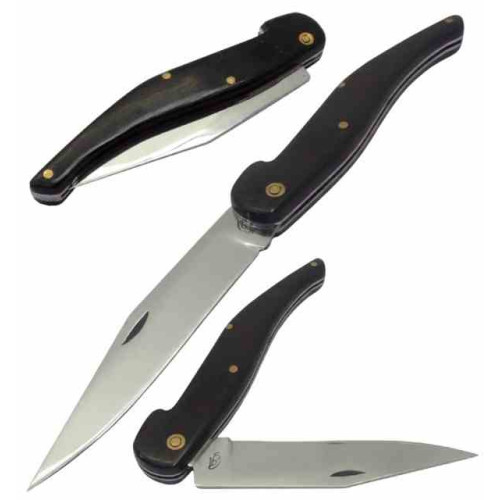
Nikolai Pergelov Kondre Granadillo Wood. The Kondre (Bulgarian: Кондре or Кундре) folding knife is one of Bulgaria’s most iconic and traditional cutlery designs. It originates specifically from the village of Kostenets (село Костенец), located at the foot of the Rila Mountains. Below, we detail its historical context, characteristics, and the origin of its name:
1. Historical Context: The Kostenets Cutlery Tradition. The village of Kostenets has a documented history of metalworking and knife-making dating back to the Ottoman Empire (18th and 19th centuries). During its heyday, the village was home to over a hundred master cutlers (*ножари*), whose work supplied markets throughout the Balkan region. Like other traditional Bulgarian knives from the same area—such as the *Krache* (featuring a handle shaped like a leg or a boot)—the *Kondre* served as an essential pocket tool for shepherds, farmers, artisans, and travelers. Although industrial production drastically reduced the number of workshops following World War II and throughout the socialist era, several local masters kept the tradition alive. Today, third-generation contemporary artisans in Kostenets continue to craft the *Kondre* model, remaining faithful to its historical silhouette.
2. What is the origin and meaning of the name "Kondre"?: In the oral and ethnographic tradition of the Balkans, the term *Kondre* (also locally pronounced and written as *Kundre* / Кундре, or associated with *Kosturka* / Костурка) has two primary explanations regarding its origin: The ethnographic tradition of the "women’s" or "midwife’s" knife: According to researchers and collectors of traditional cutlery from Kostenets, the word *kundre* historically referred to a "women’s knife" (*женски нож*)—a small, sharp, and manageable tool that village midwives carried and traditionally used to cut the umbilical cords of newborns. Over time, the name became established as the designation for this specific pattern of lightweight folding knife. A Balkan linguistic root (curved shape / footwear): In various archaic dialects of the western and central Balkans (in the border region between Bulgaria, Serbia, and Macedonia), the word *kundre* (кундре) literally means "shoes" or "traditional footwear" (resembling *opanci*, or shoes with curved, pointed toes). In traditional Bulgarian cutlery, it is common to name folding knives based on the shape of their handle (as is the case with the *Krache*, which means "little leg" or "little foot"). The pronounced, ergonomic curvature of the *Kondre* handle—reminiscent of the arched profile of a traditional shoe or a shoemaker’s last—reinforces this popular name.
3. Distinctive design features: As can be seen in the piece shown in the photograph, the handle features a stylized profile in the shape of a gentle "S" or an arc. In its most classic versions, it lacks a front metal bolster; instead, the handle scales are riveted directly onto the liners (traditionally crafted from walnut or plum wood, deer antler, or buffalo horn). The blade is slender, featuring a very sharp clip-point profile, a nail nick for manual opening, and a simple friction or slipjoint mechanism. Its lightweight design made it an ideal pocket knife to carry tucked into a sash or in a pocket without creating a bulky profile.
Materials:
Blade: 440B stainless steel.
Handle: granadillo wood.
Lock System: slipjoint.
Measurements:
Blade: 100 mm.
Overall: 235 mm.
Closed: 135 mm.
Tickness: 2 mm.
Weight: 105 grs.
Made in Bulgaria.
Lorem Ipsum is simply dummy text of the printing and typesetting industry. Lorem Ipsum has been the industry's standard dummy text ever since the 1500s, when an unknown printer took a galley of type and scrambled it to make a type specimen book.
- Availability: In Stock
- Product Code: Kondre Granadillo 135
